 Skip to content

STEAM Engine - Top Robotics & Coding (STEAM) Learning Centre in Singapore (Potong Pasir)
STEAM = Science, Tech, Engineering, Art, Math (Not just STEM Learning!)
Why Choose STEAM Engine?
At STEAM Engine, we don't just teach kids how to code; we teach them how to think.
1. Backed by 15 Years of Excellence: Through our affiliation with Duck Learning—LEGO® Education’s exclusive partner in Singapore for the last 15 years—we bring unparalleled expertise and the latest, globally recognized tools directly to your child.
2. Certified Expert Trainers: Your child is in the best hands. All of our educators are officially certified by the LEGO® Education Academy, ensuring the highest standard of engaging, effective, and supportive instruction.
3. 100% Hands-On: We believe in learning by doing. Every session is packed with practical building, testing, and iterating so students can see their ideas come to life.
4. Future-Ready Soft Skills: Beyond the screen, our students build resilience, practice effective communication, and learn the true value of teamwork.
Premium Workshops & Courses
Quality Tools & Experienced Trainers
Private & Group Sessions
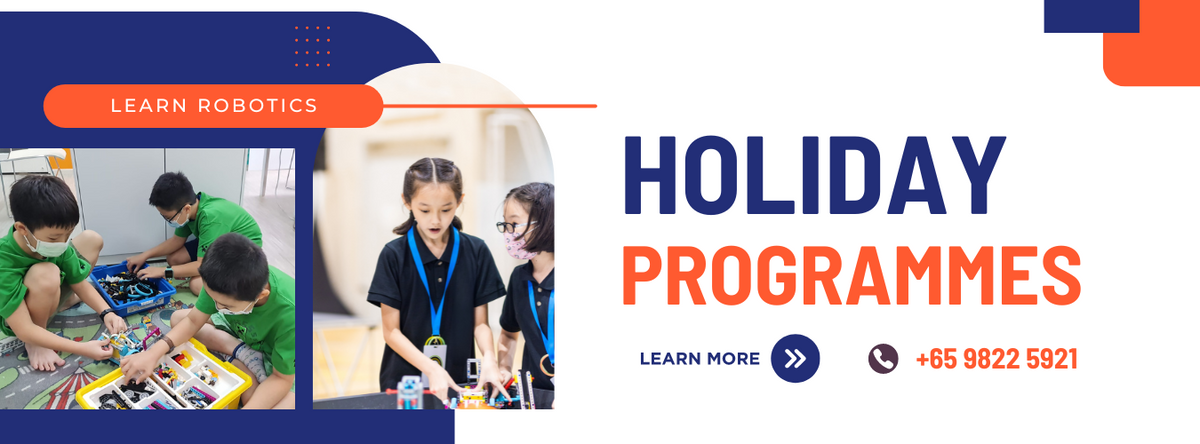


Junior Robotics: Start Small, Think Big
1) Beginner CourseDuration: 15 Hours (10 sessions x 1.5 Hrs) | Cost: $572 (GST incl.)
The Experience: We use relatable stories and colorful bricks to introduce the exciting world of robotics.
What They Learn:Foundational Building: Construct sturdy models using bricks, simple motors, and color matrices.Intro Coding: Master sequencing using a highly visual, drag-and-drop, icon-based interface.
Confidence: Encourage trial, error, and celebrating every successful build!
2) Intermediate CourseDuration: 15 Hours (10 sessions x 1.5 Hrs) | Cost: $572 (GST incl.)
The Experience: For those with basic coding experience, we transition to open-ended challenges that test creativity and logic.
What They Learn:Smarter Mechanisms: Incorporate color sensors and complex gearing for responsive models.Level-Up Coding: Transition smoothly from icon-based to Scratch-based word blocks.
Communication: Practice explaining their creative design process to peers.
Senior Robotics: Engineering Excellence
1) Beginner CourseDuration: 20 Hours (10 sessions x 2 Hrs) | Cost: $765 (GST incl.)
The Experience: The perfect introduction to building sturdy mechanical structures and bringing them to life through fun, hands-on challenges.
What They Learn: Engineering Basics: Master LEGO® Technic elements, motors, and smart hubs.Sensor Integration: Use color, force, and ultrasonic sensors to interact with the environment.
Problem Solving: Apply the true engineering design process: build, test, improve.
2) Intermediate CourseDuration: 20 Hours (10 sessions x 2 Hrs) | Cost: $765 (GST incl.)
The Experience: Tackle open-ended, real-world challenges that require smarter code. An excellent stepping stone to competitive robotics!
What They Learn: Advanced Mechanisms: Build complex gear trains, steering systems, and multi-motor attachments.
Next-Level Coding: Master variables, loops, conditional statements, and data logging.Precision: Program robots to navigate autonomously with high accuracy.
National Robotics Competition 2026 Preparatory Courses
Preschool Category (Ages 4-6)
Tool: KUBO Robotics
Duration: 18 Hours (12 sessions x 1.5 Hrs)
Cost: $690.00
The Experience: A captivating series preparing our youngest innovators for the big stage! Through engaging activities with the screen-free Kubo robotics set, children delve into foundational computational thinking.
Focus: Fostering early creativity and problem-solving, culminating in the thrilling debut of their robot at the NRC in August!
Lower Primary Category (Ages 5-9)
Tool: LEGO® Education SPIKE™ EssentialDuration: 30 Hours (15 sessions x 2 Hrs)
Cost: $1145 (3 Installments available)
Focus: Tackling specific thematic missions, coding consistent sequences, practicing teamwork, and confidently presenting to judges.
Upper Primary Category (Ages 8+)
Tool: LEGO® Education SPIKE™ PrimeDuration: 30 Hours (15 sessions x 2 Hrs)
Cost: $1145 (3 Installments available)
Focus: Rulebook analysis, strategic route optimization, building highly reliable attachments, and competitive engineering under strict time limits.
Trail Classes
Cost: $70.00
Check out if this is what works for your child.

Testimonials & Reviews


Robotics & Coding Resources for Parents

What is STEM and STEAM education in Singapore?
The blog discusses the evolution of education in Singapore, particularly focusing on the transition from STEM (Science, Technology, Engineering, and Mathematics) to STEAM (which includes Arts alongside the STEM disciplines). It highlights the key aspects of STEAM education, emphasising the importance of integrating creativity, critical thinking, and problem-solving skills into traditional STEM subjects. STEAM education in Singapore is portrayed as a holistic approach that prepares students for the demands of a technology-driven world economy. The government, educational institutions, and various organisations are actively promoting STEAM education through specialised schools, enrichment programs, competitions, and industry partnerships. The blog also compares STEM and STEAM education, pointing out that while both aim to foster critical thinking and innovation, STEAM places additional emphasis on creativity and design thinking. It suggests that STEAM offers a more well-rounded approach to education suitable for the 21st-century workforce. Overall, the blog advocates for the importance of STEAM education in Singapore, highlighting its role in nurturing future innovators and contributing to the country's economic development and global competitiveness.

What is the Applied Learning Program (ALP) in Singapore?
Applied Learning Programs (ALPs) are reshaping education in Singapore, promoting hands-on, real-world application of academic knowledge. Implemented across all primary schools by 2023, ALPs emphasise project-based learning, interdisciplinary approaches, and the development of 21st-century skills. Key Features: Project-based Learning: ALPs engage students in authentic projects, fostering collaboration with external partners and addressing community needs. Interdisciplinary Approach: Integrating diverse subjects, ALPs cultivate holistic problem-solving skills essential for future success. Real-world Application: ALPs encourage students to apply learning to solve real-world issues, fostering civic engagement and responsibility. 21st-century Skills Development: ALPs nurture critical skills like problem-solving and collaboration, preparing students for future careers. Primary vs. Secondary ALPs: Primary ALPs focus on core subjects, while secondary ALPs extend to advanced topics like STEAM and Robotics. ALP vs. Co-Curricular Activities (CCA): ALPs deepen understanding by connecting knowledge to real-world scenarios, whereas CCAs broaden students' experiences through extracurricular activities. Themes Covered: ALPs encompass diverse themes such as Game Design, Health Science, and Sustainability, enriching students' learning experiences.

Top 10 Tips for Educators to teach STEAM Education to Preschoolers (Age 4+)
Duck Learning aims to provide valuable insights and practical tips for preschool teachers to effectively incorporate STEAM (Science, Technology, Engineering, Arts, and Mathematics) education into their classrooms. It begins by defining STEM and STEAM concepts for preschoolers, emphasising their holistic approach to learning and problem-solving. The article then explores the essential components of STEM and STEAM education, along with corresponding skills. It delves into the importance of creativity and innovation in STEAM education, highlighting its interdisciplinary nature and relevance in preparing children for future careers. The blog offers ten actionable tips for teachers, including integrating play, fostering curiosity, embracing hands-on learning, and promoting teamwork and collaboration. Each tip is accompanied by practical suggestions and examples, making it easy for teachers to implement STEAM education effectively. The article concludes by emphasising the significance of STEAM education in nurturing young minds and providing them with essential skills for success in the modern world.
What is STEM and STEAM education in Singapore?
The blog discusses the evolution of education in Singapore, particularly focusing on the transition from STEM (Science, Technology, Engineering, and Mathematics) to STEAM (which includes Arts alongside the STEM disciplines). It highlights the key aspects of STEAM education, emphasising the importance of integrating creativity, critical thinking, and problem-solving skills into traditional STEM subjects. STEAM education in Singapore is portrayed as a holistic approach that prepares students for the demands of a technology-driven world economy. The government, educational institutions, and various organisations are actively promoting STEAM education through specialised schools, enrichment programs, competitions, and industry partnerships. The blog also compares STEM and STEAM education, pointing out that while both aim to foster critical thinking and innovation, STEAM places additional emphasis on creativity and design thinking. It suggests that STEAM offers a more well-rounded approach to education suitable for the 21st-century workforce. Overall, the blog advocates for the importance of STEAM education in Singapore, highlighting its role in nurturing future innovators and contributing to the country's economic development and global competitiveness.
What is the Applied Learning Program (ALP) in Singapore?
Applied Learning Programs (ALPs) are reshaping education in Singapore, promoting hands-on, real-world application of academic knowledge. Implemented across all primary schools by 2023, ALPs emphasise project-based learning, interdisciplinary approaches, and the development of 21st-century skills. Key Features: Project-based Learning: ALPs engage students in authentic projects, fostering collaboration with external partners and addressing community needs. Interdisciplinary Approach: Integrating diverse subjects, ALPs cultivate holistic problem-solving skills essential for future success. Real-world Application: ALPs encourage students to apply learning to solve real-world issues, fostering civic engagement and responsibility. 21st-century Skills Development: ALPs nurture critical skills like problem-solving and collaboration, preparing students for future careers. Primary vs. Secondary ALPs: Primary ALPs focus on core subjects, while secondary ALPs extend to advanced topics like STEAM and Robotics. ALP vs. Co-Curricular Activities (CCA): ALPs deepen understanding by connecting knowledge to real-world scenarios, whereas CCAs broaden students' experiences through extracurricular activities. Themes Covered: ALPs encompass diverse themes such as Game Design, Health Science, and Sustainability, enriching students' learning experiences.
Top 10 Tips for Educators to teach STEAM Education to Preschoolers (Age 4+)
Duck Learning aims to provide valuable insights and practical tips for preschool teachers to effectively incorporate STEAM (Science, Technology, Engineering, Arts, and Mathematics) education into their classrooms. It begins by defining STEM and STEAM concepts for preschoolers, emphasising their holistic approach to learning and problem-solving. The article then explores the essential components of STEM and STEAM education, along with corresponding skills. It delves into the importance of creativity and innovation in STEAM education, highlighting its interdisciplinary nature and relevance in preparing children for future careers. The blog offers ten actionable tips for teachers, including integrating play, fostering curiosity, embracing hands-on learning, and promoting teamwork and collaboration. Each tip is accompanied by practical suggestions and examples, making it easy for teachers to implement STEAM education effectively. The article concludes by emphasising the significance of STEAM education in nurturing young minds and providing them with essential skills for success in the modern world.